The Mucem library
The library is open to researchers and students, as well as local residents, by appointment in the mornings and free access in the afternoons, Monday to Friday. Most of its collections can be borrowed, and registration is free.
Created in June 1937 when the Musée des Arts et Traditions Populaires (MNATP) opened in Paris, the Mucem library has seen its collections grow rapidly, particularly through the study of popular arts, literature and imagery.
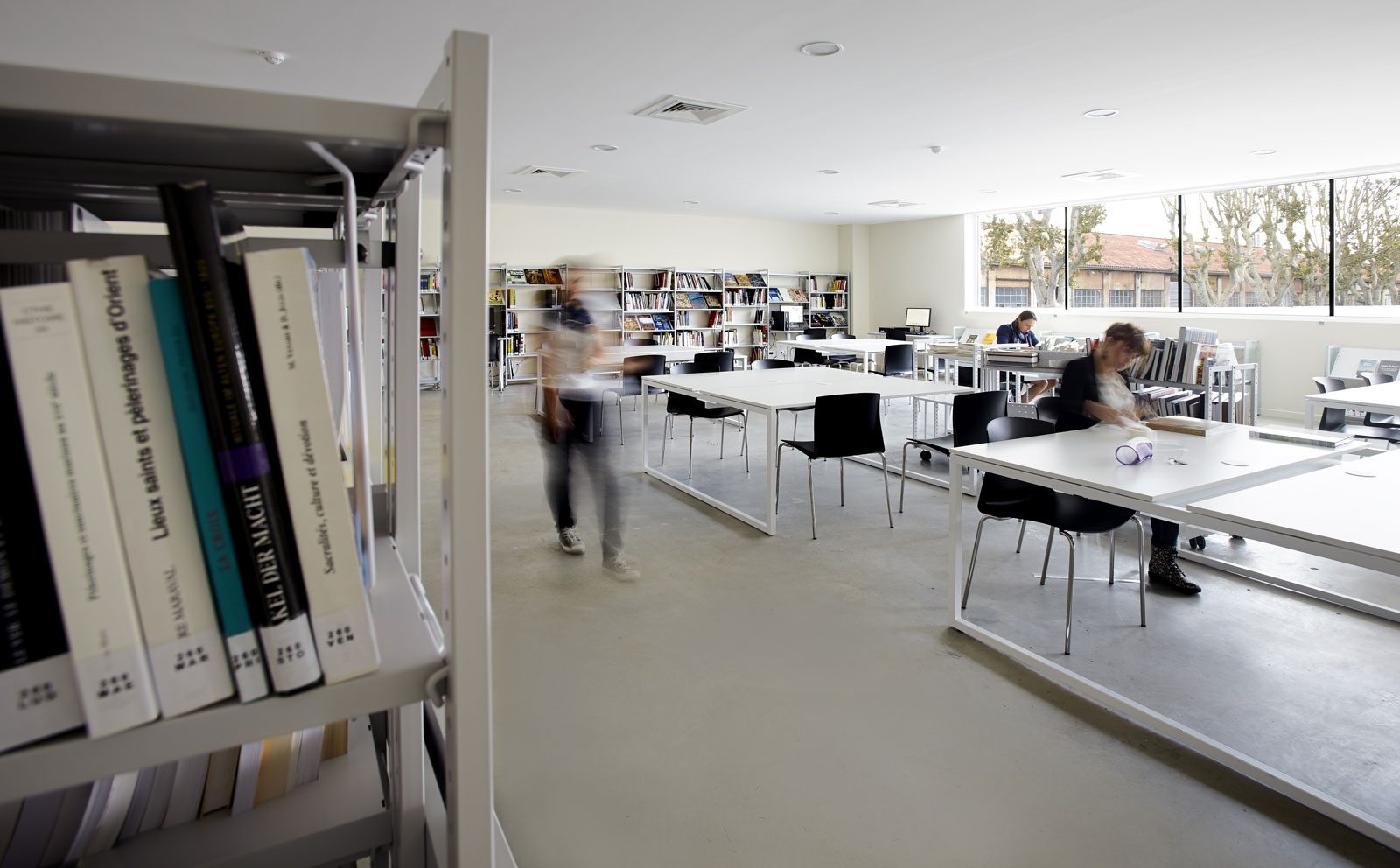
Library missions
The library is part of the Mucem’s major missions. It contributes by all scientific and cultural means to the study and understanding of these Mediterranean and European civilizations and societies, and to the exploration of the links that unite Europe and the Mediterranean, by constantly enriching its collections on these themes. It also contributes to education, training and research in the fields of anthropology, archaeology, history, art history, museography and, more broadly, other disciplines in the humanities, by making its works available to researchers and the general public, as well as through mediation aimed at school groups. Located in a working-class neighborhood, the library is committed to opening its doors to the local public, offering collections adapted to contemporary issues and to the diversity of the public who use it.
The library contributes to the documentary enrichment of the museum’s collections within the Collections and Documentary Resources Department. The library’s holdings have been built up by documenting the themes of exhibitions and collected surveys, in line with the ethnological approach of the Musée de Société, which has historically been devoted to the study of popular arts.
Conceived as a tool for disseminating the collections in addition to its conservation function, the Centre de Conservation et de Ressources (CCR) is a space for promoting the collections. The reading room is available for consultation of works on reserve and for free access. Part of the library’s heritage holdings has been digitized and is due to be put online. These holdings are regularly displayed at exhibitions.
The collections
The Mucem library offers a wide selection of contemporary and older books and magazines. There are some 200,000 books and magazines, including 5,000 antiquarian books (mainly dating from the 18th century) and 4,000 periodical titles, two-thirds French and one-third foreign. Some 3,250 titles of these periodicals are listed in the Sudoc-PS catalog.
A vast selection of children’s and adult books, comics and magazines is on display in the reading room, and can be borrowed with free library registration.
Thematic fields cover many areas, including social anthropology, archaeology, folk arts, ethnography, ethnology, folklore, social science methodology and museology. The library is a center of excellence in the fields of song, circus and performing arts, folk tales, folklore and traditions, and music hall. Generally speaking, all the themes addressed by the Musem in its exhibitions and programming are followed by the library, which offers visitors the chance to explore these themes in greater depth.
The collection’s outstanding holdings include 5,000 popular prints (peddler literature or bibliothèque bleue), several hundred almanac titles, 10,000 musical scores, and special collections: Charles-Brun (regionalism), Van Gennep (folklore), Delarue (storytelling), Dauven (circus and music hall) and Maget (ethnology), Camps (Berber worlds), Galley (Malta and Maghreb oral literature), Gandini (Morocco, Tunisia, Mauritania, Indochina).
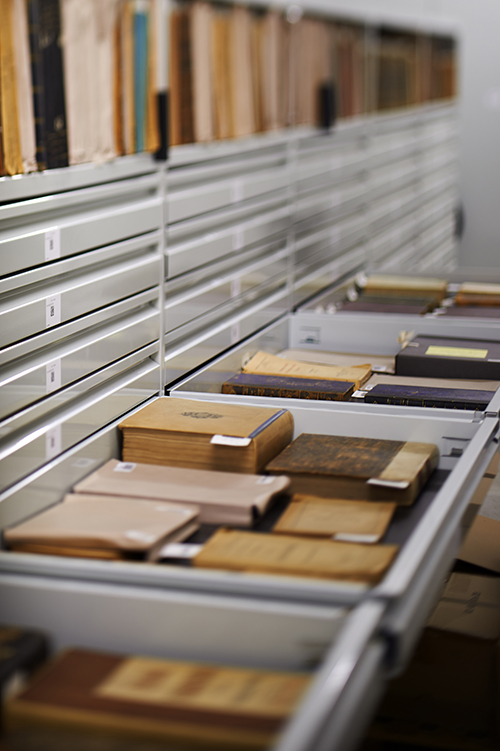
Visite de l'appartement témoin au Centre de conservation et de ressources - Photo Mucem Focus on popular prints
The Mucem library holds one of France’s three major collections of pedlars’ literature, along with the BnF and the Médiathèque de Troyes. The collection was built up through donations and purchases between 1938 and 1989. Published from the 17th to the 19th century, these booklets are generally small (10 to 20 cm), with tight page layouts, short paragraphs and little iconography. These books were sold at low prices: in Paris and other cities, in bookshops, but also in villages, by peddlers. This collection was presented in the “Bibliothèques Bleues” exhibition in 2021.
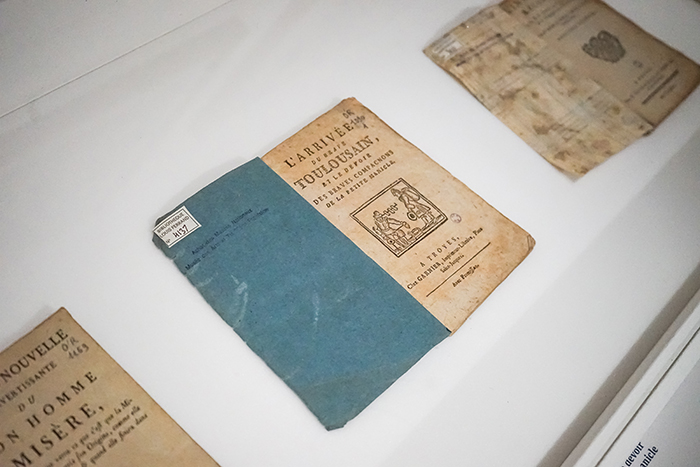
Extrait de l'exposition « Bibliothèques Bleues » au Centre de conservation et de ressources - Photo Mucem / Julie Cohen History of the library
Reading room of the MNATP library, Ph.1971.94.91 Photo Mucem / Jean-Dominique LajouxThe library was created in June 1937 with the Musée des Arts et Traditions Populaires (MNATP) within the Palais de Chaillot in Paris, but the museum was to open to the public in 1972 in the Bois de Boulogne when a site was dedicated to it. Its initial collection came from the personal library of Georges Henri Rivière (1897-1985), a leading figure in modern museology and founder of the MNATP, who bequeathed 600 volumes to the museum.
The collections grew rapidly, thanks in particular to intense research and collection activity during the war years, with 8,404 works registered with the library by 1944.
In 1969, the MNATP moved from the Palais de Chaillot to more spacious premises in the Bois de Boulogne, where it could accommodate an ever-growing collection. The library is part of the network of national museum libraries, and depends on both the museum and the Centre d’Ethnologie Française (CNRS). It covers a wide range of fields of study and aims to be “specialized-public”. It is specialized, but open to all, from museum visitors who want to learn more, to students and researchers.
The museum was a great success with the public in the 70s, with the opening of the study gallery in 1972 and the cultural gallery in 1975. By the early 90s, however, attendance was declining.
In response to the crisis facing the MNATP, the Musée des Civilisations de l’Europe et de la Méditerranée (Mucem) was designed in 2001 to be located in Marseille. It will be housed on two sites: one on the old port, in a building designed by architects Rudy Ricciotti and Roland Carta and linked to Fort Saint-Jean by a footbridge, and one in the Belle de Mai district. The latter, designed by architect Corinne Vezzoni, was built on the site of the former Le Muy barracks, and is intended to house the museum’s reserves as well as the conservation and resource center (CCR).
The library’s collections were then moved to the JRC’s reserves and reading room. Opened in 2013, the current 175m2 reading and consultation room houses around 10,000 freely-accessible books and periodicals, and seats 24.

Salle de lecture de la bibliothèque du MNATP, Ph.1971.94.91. Photo Mucem / Jean-Dominique Lajoux
How to register
Anyone wishing to consult documents held in reserve, or to borrow books and magazines, must register in order to obtain a personal card which entitles the holder to a free subscription valid for one year from date to date. Subscriptions and renewals are subject to presentation of the following original documents:
- Valid identification
- Fill in a registration form, which includes a sworn declaration of domicile.
- Parental consent for minors.
Educational workshops at the library
Librarians offer storytelling workshops and a workshop on secularism and the three great monotheistic religions for school groups. Using various documents and bibliographic research, students apply a scientific approach to understanding the representations of the great monotheistic religions.
For further information, please contact: reservationccr@mucem.org
Opening hours
Open Monday to Friday, 2pm to 5pm, and by appointment, 9am to 12:30pm.
Special opening hours from 10am to 6pm on the European Heritage Days weekend.
Please bring proof of identity with you when you visit the JRC.